Showing posts with label sequel. Show all posts

Monday, 27 April 2015

Avengers: Age of Ultron (2015)


I've enjoyed most of the Marvel films I've seen, but I don't embrace them all equally.  The Iron Man films were all excellent, and my opinion of 'Guardians of the Galaxy' (2014) is identical to everybody else's opinion of 'Guardians of the Galaxy'.  I found 'Captain America' and 'Thor' (both 2011) to be flashy but ordinary, and 'Age of Ultron' shares one of the main issues I had with 'Thor' - in both cases, the central conflict looks to be morally complex, but the villain, after a short period of seeming to have an interesting motivation, decides to be entirely, overtly, evil.  Both films promised to be dramas, and both gave way to something less challenging.

'Avengers: Age of Ultron' is a film full of punching.  Iron Man is a very cool person, whom money and technology have blessed with super punching powers; he's better served by his own films, and the fact I'd seen the superlative 'Iron Man 3' (2013) so recently probably injured my opinion of this movie.  The Hulk is a very nice guy, with an interesting central conflict - the same as in the last Avengers film (2012), so it's hard to be quite so engaged by it this time around; technology has given him super punching powers too.  Captain America is an all-American hero, and a bit boring, and technology has given him super hitting-people-with-a-shield powers.  Thor is a Norse space-god, and space-magic indistinguishable from advanced technology has given him hitting-people-with-a-mallet powers.  Then there's Black Widow, who doesn't seem to have any technological advantage, and seems to kick people more than she punches, and Hawkeye, who's really good at shooting really good arrows.

They're all incredibly attractive, but in different ways.  They kick ass, and especially much they punch ass.  Most of them have had films of their own, showing that they're all individually capable of bringing down vast, blockbuster-sized enemies, so once they're all working together, the obvious problem is finding an enemy that takes them two hours to stop.  Thankfully the legion that confronts them this year is one that can be affected by punching, but one great enough in number that the punching can go on for at least twenty minutes unabated.

Ultron, whose age it is.
The side of evil is given a number of assets, making this Age of Ultron seem a relatively tricky case, but as more and more of the villain's forces defect to the side of good, a victory for the heroes looks ever more likely.  The film seems to keep promising that nobody is safe, that this fight will have a terrible cost - and so it should!  A villain as powerful as Ultron would seem more of a credible threat if his plot had a body count.  I was disappointed when 'The Return of the King' (2003) saw all its main heroes survive - I'd hoped for a bloody hobbit-massacre to show the extent of the threat Frodo faced, and when everybody lived it made the 9-hour struggle feel cheap and easy.  I didn't hold out any such hopes this time around - but I won't say any more, for fear of spoiling the film.

'Avengers: Age of Ultron' is pretty exciting to watch - explosions, set-pieces, familiar characters doing their thing, witty exchanges and reasonable angst - but as you may sense from the paragraphs above, I wasn't quite satisfied.  Part of the problem was that there were no ordinary people in the cast of characters.  All the major players are well-versed in superheroism and high-octane showdowns.  There's no young Steve Rogers, no Pepper Potts, no Foggy Nelson, and none of the heroes even need to pass for normal - these are heroes who have given up their secret double-lives.  I think I've really been spoiled by Marvel's other 2015 project, 'Daredevil', which has recently shown up on Netflix - a hugely satisfying masked vigilante story, with dozens of interesting, human characters to care about.  'Age of Ultron' tries to put Hawkeye at its emotional core, and shows him to be ordinary and American and handsome, but this doesn't make him especially interesting.  He's no Matt Murdock.

The only real people in this film, with lives as humdrum as our own, are the huge crowds of potential victims.  The Avengers work to save these hapless lemmings, and it makes ordinary humanity seem a real drag, a hindrance without merit.  I like that these superhero films spend time showing the heroes rescuing people - it worked well in the recent Batman movies, and it was a nice feature of 'The Avengers Assemble' (2012), but here I spent my time wishing the villain would do his thing, wipe out these troublesome extras, and move the narrative on a bit.

Check it out in cinemas now (or in cinemas next week, if you're American).  Despite my complaints, there's plenty to enjoy here.

Thursday, 26 September 2013

Beneath the Planet of the Apes (1970)


This sequel to 1968's sci-fi classic 'Planet of the Apes' spends its first half telling the same story again with a different astronaut, but in the second half moves unexpectedly to an underground realm of skinless psychics who sing hymns to a gigantic bomb.

Like the earlier film, it starts eerily, with wide empty spaces, perils of nature and troubling mysteries even before we reach the Apes.  Here, too, there's a lengthy sequence where our hero isn't permitted to speak, but must nonetheless get things done - it's always good, in this visual medium, to have a respite from talking.  We then get the same exposition and capture-and-escape antics as last time, before the new mystery and fresh ideas are allowed to take hold.

The Apes look pretty good here, riding to war.  When they get there their
lack of numbers and weapons makes the conflict seem terribly small-scale.
It isn't very clear why they go to war, nor who they expect to fight.
Charlton Heston has opted out, so his character, Taylor, is written out at the start (once we've seen a reprise of the earlier film's famous ending) and only returns in the dying minutes, to have an excellently exciting mace fight with this film's Taylor-substitute, Brent (James Franciscus).  There's a rare thrill to seeing the hero of a film you're watching fight to the death with the hero of an earlier, better movie.  We're torn over which we want to win, or we're meant to be.  Brent has the advantage that we've spent an hour getting to like him, but Charlton Heston is Charlton Heston, and though he fights the more savagely, he seems the more original of the two.  Perhaps if Brent hadn't been so clearly a Heston-lite it would seem a fairer competition.

Charlton Heston turns up, eventually.
There was a brief period when the outlandish bomb-worship and the film's excessively destructive climax made this my favourite of the five classic Apes movies.  I came round, in the end, to the greater merits of the '68 original, but think I would claim the third film, 'Escape from the Planet of the Apes' (1971) as the best of the bunch, a weird fish-out of water comedy in modern-day America which very slowly darkens into a bleak and unfair tragedy, its villain genuinely trying to save humanity, and its dearth of Charlton Heston made up for by the presence of Ricardo Montalban.

They're appealing films, each one more utterly miserable in its findings than the one before.  The first is about how human appetite for destruction never ceases, the second about how we cause the end of the world, and it somehow gets even worse as the series goes on, with films about killing babies and smashing people's heads in as borderline-legitimate ways to make the world better.  The movies have the most paranoid soundtracks, an alarming and unusual set of noises for an orchestra, at the time - and they're attractive to look upon.  I always envy Taylor's linen mace-fighting jacket in this instalment, and if I hadn't broken my sewing machine I would  surely have replicated some of the Apes' garments by now, pleasing designs which look like no human culture I could name.

This is probably the only Apes movie where you could take the Apes out
and the plot would still more-or-less work.  Nice costumes, though.
The things that most date the film to 1970 (or more properly to the late sixties when it was written and filmed) are the use of wild camera zooms and the fact that the only notable African American character is simply credited as 'Negro', which any later would surely have seemed questionable.  The film is also quite Vietnam-flavoured, with the Gorillas going into battle, but first breaking up ineffectual anti-war protests by the Chimpanzees.  On the day I viewed this film I went along to an unfortunately unpeopled anti-fascist rally, so I was rather relieved to see this film present an even smaller and less effective protest by which I could make some happier comparison.


P.S. Brent spends the film looking for Taylor, but never expresses an interest in the three astronauts who travelled with him.  Presumably he knows which of the four was played by Charlton Heston.


Thursday, 14 February 2013

Das Testament Des Dr Mabuse (1933)


Murder!

Mabuse, villain of the earlier 'Dr Mabuse, Der Spieler' (1922) has, since his arrest, gone insane and possibly then gone sane again.  He sits in the asylum, wild-eyed and wild-haired, never speaking a word, but writing page after page after page of instructions on how to commit perfect crimes.  And far across the city, somebody is committing those crimes.

This is recognisably the same Berlin as in 'M' (1931).  The criminal criminal underworld acts with a certain gusto, and seems a relatively agreeable side of society, for those willing to join in - living, laughing and cooking sausages together when not indulging in petty crimes.  The only real evil among them comes from those rare crimes, murders.

Thomas Kent and Lilli in a soggy situation

At the four corners of this adventure are are the aforementioned Dr Mabuse; Professor Baum, the psychiatrist who studies him; Thomas Kent, a handsome and for-some-reason-American-named, basically law-abiding crook who won't commit the murderous instructions passed down from his unseen master; and reprising his role from 'M', the excellent Otto Wernicke as the equally excellent Inspector Lohmann.

Unusually, the presence of both Lohmann and Mabuse makes this a sequel to two different films, taking the hero from one and the villain from the other.  I haven't seen 'Dr Mabuse, Der Spieler' (1922), but I was delighted to see the return of Lohmann (or rather, I'd forgotten him utterly, as I hadn't seen 'M' for five years when I watched this, but he was so enjoyable here that I immediately rewatched 'M' and was delighted to see him return there, even if it was more of a pre-turn).  It's a full-blooded performance with a great amount of humour where it's needed.

The Spectre of Mabuse over Professor Baum

Mabuse is suitably sinister and cadaverous, and is played here by Rudolf Klein-Rogge, who was the fascinatingly alien Koenig Etzel (that's Attilla the Hun, to you or me) in 'Die Nibelungen' (1924) and Rotwang in 'Metropolis' (1927).  Yet more frightening, perhaps, is Professor Baum (Oscar Beregi, Sr.).  Film after film, from the thirties to the sixties, show psychiatrists as more prey to neuroses and what used to be termed 'criminal insanity' than anybody they might actually treat, so it's little wonder they're so feared today, and 'Das Testament Des Dr Mabuse' gives us a classic example.  It beats Hitchcock's 'Spellbound' (1945, often counted with popularising all the main psychiatrist stereotypes) by a good decade.  This whole film, in fact, has a great deal of Hitchcock to its style and flavour, and it would surprise me very little to hear he'd given it his attention.

I can see why this is less well remembered, at least in the English-speaking world, than 'M' (1931), which got there first, and had Peter Lorre on its side - but it's a pity that, bar the odd Amazon recommendation, I've never heard this spoken of.  Anyone who enjoys 'M' enough to rewatch it will find a great many of its merits reproduced here.  The special effects are as bold as I've now come to expect from 20s and 30s cinema, and the DVD cover is an exciting one indeed.  Perhaps not the right way to judge a film, but it's a test that's often led me right in past.


Tempted to investigate?

Sunday, 20 January 2013

The Lord of the Rings (2001-2003)


Who determined that men must wear their hair short?  Someone, somewhen must have decreed it, and done so with great power.

These are the films that made me grow my hair long.  Everybody here (and in 90 per cent of this adventure, 'everybody' is synonymous with 'all the male characters') - the wizards, the men and the dwarves, have long, magnificent, flowing hair.  The hobbits have rather less, but still a good deal more, I'd say, than the male average when the thing saw release.  How I admired the hair (and the general style and bearing, but the hair seemed both achievable and symptomatic) of Aragorn, of Elrond, of Gandalf the Grey, the most magnificent.

It's been long and short ever since.  It takes time to make it long but I ill care for it, or the pressures of 21st century Britain demand its loss.  I think I'd still be glad to grow up to be Bilbo or Radagast (but now, you see, I'm talking in the wrong film), but am wary of letting my pate come to resemble that of Grima Wormtongue or Jimmy Saville.  Ah, you cry, this is not a hairdressing blog.  Indeed not!  Shall we return to the matter at hand?


The Fellowship of the Ring (2001)

Sean Bean is Boromir.  Doomed, of course.

Well, you've all seen these films, perhaps several times at ever-increasing lengths, so there's little I can tell you about the content.  The big surprise, rewatching this first part, is how real some of the locations look.  I've always accepted the grand locations augmented by CGI and cunningly composited model-shots in the later films, without consciously registering that this is how they were put together, but the places roamed through in 'The Fellowship of the Ring' feel like real places you could visit - as if anybody with a camera and a few Orcs could go and gather the same footage, without having to find a portal to a real fantasy kingdom to get the scenery they're after.  Only a handful of slightly dodgy slo-mo footage seems to date the film, the remainder seeming magnificently timeless.

The fellowship is peopled by excellent characters, well-cast.  Four hobbits, two men (one dark and handsome; the other Yorkshire and treacherous), a wizard (Gandalf, of course), an elf (Legolas manages to be stylish, effete and dully humourless all at once) and a dwarf (Gimli is somehow very Scottish and very Welsh at the same time - an excellent combination).  For some reason, this is the only one of the films where we see dwarves other than Gimli.  Presumably they're occupied somewhere else during the ensuing world-war, but they could have made a few of the battles much less precarious if they'd done as the Elves do and sent a couple of battalions to Helm's Deep or Pelennor Fields.

A friend of mine, who presents the Minute Doctor Who Podcast, suggested that Elijah Wood was poor casting for Frodo, and that this was the films' greatest hindrance.  It seemed a curious suggestion to me - perhaps because I watched the films long before reading the books, so to me he is Frodo and Frodo is him.  The vibrant relationship between him and Sean Astin's Samwise Gamgee is the heart of the films, and everything else is window-dressing - even the battles, even Gandalf, even the pretty lights and colours of the Balrog and the fireworks and the eye of Sauron.


The Two Towers (2002)

Frodo, perhaps about to kill slimy old Gollum.

So the Fellowship fell to pieces.  I expected this film to show them taking separate routes only to be reunited and carry on as before, but by the time this sequel starts, they're irreparably divided, like Earth in the time of Peleg, and we're following several stories at once.

I'll take this chance to say something about sequels, as it seems to bear some relevance to this blog and experiment.  I'm meant to be looking at a hundred films from a hundred years, but it doesn't seem quite right to take up three per cent, and three consecutive years, on The Lord of the Rings - a fine series, but one with a very consistent style.  It's better, perhaps, to count it as one big film, and tie it to just one of those years, allowing me to re-use 2001 for 'Moulin Rouge' and 2003 for 'Good Bye Lenin' (for instance).  I'll apply the same thinking to my 1971-3 trio of Shaft movies.  If I didn't go with this sort of thinking, I'd be able to have a long weekend binge of the canonical Bond movies and wipe out almost a quarter of my 100 films at the expense of variety.

Back to 'The Two Towers', then.  A sequel without new characters would be a pointless thing (please let me know if you can think of any good examples), and two fine adventurers enter here.  Firstly, the cadaverous form of Theoden, from whom Gandalf (if I may spoiler a spoiler) exorcises Saruman, and who subsequently gets his groove back, once he realises that his obviously evil servant Grima Wormtongue is evil, obviously.

I can't easily screen-cap blu-ray, so I photographed my TV.  Does it show?

Secondly, Gollum: seen in the distance in 'The Fellowship of the Rings', but a hero and a villain from here on.  Just as we've gotten used to Frodo and Sam adventuring alone, the relationship is shaken up by this CGI monstrosity.  Sam, who's been nothing but hearty good-humour and encouragement, suddenly reveals a nasty streak, despising this slimy churl, a creature who alternates saving the day and threatening murder.  It's an arresting, horrible yet sympathetic performance which owes at least a little to Peter Lorre in 'M' (1931), and it's not without reason Gollum is still so celebrated and impersonated.

There's a great deal of fighting, here as in the threequel.  I still can't tell where the real soldiers and sets end and the models and CGI begin, so I'm content to say the sequences work as impressively as intended.  Everything's beautifully designed and strikingly attractive.

Starting in this film, Aragorn has a choice of two wives - a storyline plumped up considerably to make the lack of women in these films less embarrassing.  Of course, since Aragorn is royal, and this is the real Olden Days, he could probably fix the problem with bigamy - or since he and Arwen are both very long-lived, he could marry Eowyn first, wait for her to grow old and die, and then marry Arwen.  Perhaps I'm being unduly unromantic making such practical suggestions, but I thought it worth suggesting.  As it is, Aragorn gives his full attention to his sword and his battles, perhaps waiting to see who survives before ironing out the destiny of his loins.


The Return of the King (2003)

Andy Serkis is a real person, not just the puppeteer of Gollum

'Return of the King' holds my two favourite scenes of the trilogy. First, before the film's title dares appear, we're treated to Gollum's back-story, as Smeagol and Deagol fight over the newly-found precious.  It was an unexpected delight, watching this for the first time in the cinema, to see Andy Serkis in the flesh.  An appropriate reward, I think, for his years being motion captured - his voice and movements were celebrated, but only here is his face seen.

My other favourite scene is the one with the beacons - a moment the book covers with half a sentence, but which in the film is a beautiful triumph.  Here, grizzled old Denethor is most reluctant to call for aid, but young Pippin scrambles up to light the city's waiting bonfire beacon, and once its flames have grown, we see another light spring up on the far horizon in answer.  The camera flies over distant and inhospitable mountains as beacon answers beacon, the signal going out for aid, calling stations presumably maintained for this purpose for many generations.  It's an awesome, surprisingly emotional sight.  Like the defiant singing of La Marseillaise in 'Casablanca' (1942), it gives me a thrill of hope in the midst of desperation.  For me, this is the best part of the eleven-hour adventure.

Frodo just gets dirtier and dirtier in these films, and not in a saucy way.

Watching the films in their extended form (as seems appropriate), it's easy to grow a touch fatigued during this final instalment.  The first two went up from three hours to three-and-a-half apiece.  'The Return of the King' was already three-and-a-half hours long in the cinemas, which felt about as extended as was required, and so ends up almost four-and-a-half hours in duration.  The ending sequence, which was derided (unfairly, to my mind) is under twenty minutes in length from the destruction of the ring to the start of the credits - not inappropriate when compared either to the extent of the adventure that precedes it, or to the equivalent portion of the book (more than forty-thousand words, not counting the appendices).  Twenty minutes seems about as long as one can acceptably make an audience cry with a mix of sadness, merriment and relief.  Each strand is tied up, everyone goes home, and Frodo, Gandalf, and Bilbo in his dotage resolve that they must leave Middle Earth forever.  For a happy ending, it is very sad.

Nine years later, enough time has past since this massive epic that I very warmly welcome 'The Hobbit', by way of a prequel.  But that, as they say, is another story.


You would think that the extra capacity available in a lavish blu-ray box-set would allow the inclusion of both the extended and the sensible editions of these films, wouldn't you?  Nope.

Monday, 17 December 2012

Sequels to 'Shaft' (1972, 1973)


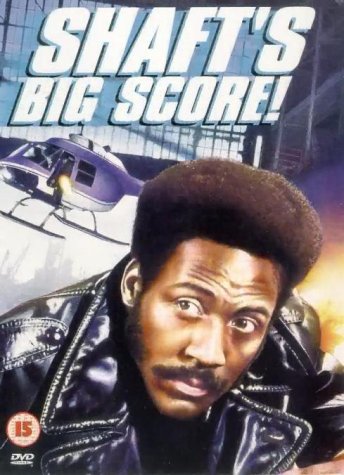
Shaft's Big Score!

'Shaft's Big Score'.  The score is money, or revenge, or possibly some sex.

'Shaft's Big Score!' has two things the original 'Shaft' lacks.  Firstly, an exclamation mark in its title.  Secondly, 'Shaft's Big Score!' has a helicopter in it.  That's the sum of its improvements and expansions.

You can tell the helicopter is a big deal.  The DVD's front cover shows John Shaft, his face showing urgency but not alarm, and behind him a looming helicopter.  One can reasonably spend 80% of the of the film in anticipation of a helicopter, wondering how and when it will explode (because any film with a helicopter on its cover or poster will, at the end, have a helicopter explosion - it's practically what these things are built for.  It's a wonder people still use them).

The film is otherwise very much like 1971's 'Shaft', but without the Isaac Hayes soundtrack.  'Theme to Shaft's Big Score!' imitates the earlier 'Theme to Shaft' in its potted biography interspersed with breathy 'Shaft's and 'John Shaft's, but comes across as a rip-off, like when Tennyson's 'Charge of the Light Brigade' proved so popular that he rushed out the near identical 'Charge of the Heavy Brigade'.  This film isn't really weaker than the first, or inherently worse, but the original was original, and this can't make that claim.

Just as 'Shaft' was adapted from Ernest Tidyman's novel of the same name, so this film is adapted from its second sequel (sadly skipping 'Shaft Among the Jews', which I'm reading at present, having found its title and cover too fascinating).  Once again, Shaft is on the trail of a weedy Caucasian with too little style and too many guns.  The baddie plays a clarinet in this one, and is after a large amount of money that's been hidden in a coffin, and was meant to be used to build an orphanage or somesuch.  The rest of the plot, a week later, is a bit of a blur, since I watched the Shaft trio in the space of three days, and this was comfortably the least amazing.

The action finale is where it's at, and was the only place from which I could draw a screen-capture that couldn't have come from 'Shaft'.  A chase with running, shooting, cars, speed-boat and that helicopter.  I certainly hope Jon Pertwee took the time to watch 'Shaft's Big Score!', as this sort of thing was right up his street - and may well have been the inspiration for the action part two of 'Planet of the Spiders'.  And does the helicopter explode?  Well I wouldn't want to spoil the end for you.

Shaft in Africa

'Shaft in Africa', or in fact, on a boat to France.

Now this is more like it.  Shaft is dispatched to Africa - mainly Ethiopia, but 'Shaft in Addis Ababa' doesn't sell the concept quite so well - and goes undercover to expose a people-trafficking operation run by a villainous and borderline-impotent white man (played here by Frank Finlay).

This is Shaft stripped down - without New York, or his usual allies, or his cool leather coat (which I envy, and was sad not to see here) - without any of his usual security.  Without his gun.  Shaft gets a dog, but it dies, so he has an overwhelmingly exciting wooden-pole fight with the man who killed it.

Until I saw this, the sole (and therefore best) people-trafficking film I'd seen was the maybe-kinda-racist 'Freight' (2010) in which my friend Jennifer Jordan played the career-defining role of 'Moldovian Woman 1', despite 'Moldovian' not being a real word.  'Shaft in Africa' knocks 'Freight' into a cocked hat, whatever that means, and is a far more interesting, exciting and emotionally involving depiction of this ongoing modern slavery.  It's depressing to think the problem was described so clearly in 1973 and is still going strong four decades later.

I'm inclined to say this film is just as good, and as socially aware as the original 'Shaft', and is a story worth telling.  Its status as a threequel and its lack of Oscar-winning theme tune have left it largely forgotten, but if you enjoyed 'Shaft', or enjoy Frank Finlay and want to see him talk about erectile disfunction and plan to shoot people and blow them up, this is certainly a film to investigate.


Have I tempted you to engage with either of these exciting motion pictures? Here they are on DVD, should you get the urge