Showing posts with label helicopter. Show all posts

Monday, 27 April 2015

Avengers: Age of Ultron (2015)


I've enjoyed most of the Marvel films I've seen, but I don't embrace them all equally.  The Iron Man films were all excellent, and my opinion of 'Guardians of the Galaxy' (2014) is identical to everybody else's opinion of 'Guardians of the Galaxy'.  I found 'Captain America' and 'Thor' (both 2011) to be flashy but ordinary, and 'Age of Ultron' shares one of the main issues I had with 'Thor' - in both cases, the central conflict looks to be morally complex, but the villain, after a short period of seeming to have an interesting motivation, decides to be entirely, overtly, evil.  Both films promised to be dramas, and both gave way to something less challenging.

'Avengers: Age of Ultron' is a film full of punching.  Iron Man is a very cool person, whom money and technology have blessed with super punching powers; he's better served by his own films, and the fact I'd seen the superlative 'Iron Man 3' (2013) so recently probably injured my opinion of this movie.  The Hulk is a very nice guy, with an interesting central conflict - the same as in the last Avengers film (2012), so it's hard to be quite so engaged by it this time around; technology has given him super punching powers too.  Captain America is an all-American hero, and a bit boring, and technology has given him super hitting-people-with-a-shield powers.  Thor is a Norse space-god, and space-magic indistinguishable from advanced technology has given him hitting-people-with-a-mallet powers.  Then there's Black Widow, who doesn't seem to have any technological advantage, and seems to kick people more than she punches, and Hawkeye, who's really good at shooting really good arrows.

They're all incredibly attractive, but in different ways.  They kick ass, and especially much they punch ass.  Most of them have had films of their own, showing that they're all individually capable of bringing down vast, blockbuster-sized enemies, so once they're all working together, the obvious problem is finding an enemy that takes them two hours to stop.  Thankfully the legion that confronts them this year is one that can be affected by punching, but one great enough in number that the punching can go on for at least twenty minutes unabated.

Ultron, whose age it is.
The side of evil is given a number of assets, making this Age of Ultron seem a relatively tricky case, but as more and more of the villain's forces defect to the side of good, a victory for the heroes looks ever more likely.  The film seems to keep promising that nobody is safe, that this fight will have a terrible cost - and so it should!  A villain as powerful as Ultron would seem more of a credible threat if his plot had a body count.  I was disappointed when 'The Return of the King' (2003) saw all its main heroes survive - I'd hoped for a bloody hobbit-massacre to show the extent of the threat Frodo faced, and when everybody lived it made the 9-hour struggle feel cheap and easy.  I didn't hold out any such hopes this time around - but I won't say any more, for fear of spoiling the film.

'Avengers: Age of Ultron' is pretty exciting to watch - explosions, set-pieces, familiar characters doing their thing, witty exchanges and reasonable angst - but as you may sense from the paragraphs above, I wasn't quite satisfied.  Part of the problem was that there were no ordinary people in the cast of characters.  All the major players are well-versed in superheroism and high-octane showdowns.  There's no young Steve Rogers, no Pepper Potts, no Foggy Nelson, and none of the heroes even need to pass for normal - these are heroes who have given up their secret double-lives.  I think I've really been spoiled by Marvel's other 2015 project, 'Daredevil', which has recently shown up on Netflix - a hugely satisfying masked vigilante story, with dozens of interesting, human characters to care about.  'Age of Ultron' tries to put Hawkeye at its emotional core, and shows him to be ordinary and American and handsome, but this doesn't make him especially interesting.  He's no Matt Murdock.

The only real people in this film, with lives as humdrum as our own, are the huge crowds of potential victims.  The Avengers work to save these hapless lemmings, and it makes ordinary humanity seem a real drag, a hindrance without merit.  I like that these superhero films spend time showing the heroes rescuing people - it worked well in the recent Batman movies, and it was a nice feature of 'The Avengers Assemble' (2012), but here I spent my time wishing the villain would do his thing, wipe out these troublesome extras, and move the narrative on a bit.

Check it out in cinemas now (or in cinemas next week, if you're American).  Despite my complaints, there's plenty to enjoy here.

Tuesday, 20 August 2013

Heimat (1984)


Heimat!  This Chronicle of Germany is a firm favourite of mine, and not just because of its fabulous duration.  Heimat and I both entered the world 29 years ago, in 1984, and it was watching this intimate overview of the century that first set me on my current course of watching a hundred films from a hundred years, making some sense of the twentieth century as a single story.  As you may note above, there is a video edition of this entry for those happier with dozens of clips than hundreds of written words.

Normally when you watch a film you sit down, you watch, things happen to characters, and you get your resolution and the film stops.  Heimat, though, just keeps going.  It is, in fact, very long, taking around sixteen hours to tell the story of a small village in rural Germany, and a family who live there.  It starts in 1919 and just keeps on rolling until its 1982, by which time our central characters have grown up, grown old and begotten from their loins the new generation of central characters.  In a film of such expanse I think it's no spoiler to say that almost everybody alive at the start of the story has died by the end.  There's something fascinatingly unusual, something Old-Testament-like, about a story in which the main characters at the end aren't present at all at the start, and the only characters we meet in the first hour aren't there at all at the end.  Heimat isn't like other films.  It's like life.

1938: Otto Wohlleben, who begat Hermann Simon
When I first saw it I made a mistake that's easy in real life too - I concentrated on the older generation, on Maria Simon, the film's main character, on Paul and Pauline and Eduard, and I ignored the children, forgetting that they would soon turn into real people, and I'd have no idea where they'd come from.  By the fifties the film has slowly switched its emphasis and become the story of Maria's children Anton, Ernst and Hermann, the last of whom went on to star in the 'Die Zweite Heimat' (1993) and 'Heimat 3' (2004), where he became the cinema character I know best and care about the most - but that's another story.  Characters who'd been the centre of their own lives, and at the heart of the community, become parents, become grandparents, they die of age or accident or war, or equally often we leap forward a few years and they're just gone, just dead.  Quite disconcertingly, the film raises the strange prospect that our grandparents may once have been children and people with lives as fun and interesting as our own.

The film is made up of a number of films - see the postscript for quite how that works - and is shot variously in colour, sepia and monochrome, and on a variety of film-stocks.  It starts almost entirely black and white,' because, y'know, things just were in those days, but is almost entirely in colour after colour television is introduced in West Germany in 1967 (August 25th, if you like to celebrate anniversaries).  It takes a little getting used to, but seems utterly appropriate given how the century's story is one of technological advancement.  Integral to the human stories playing out in the village are the introduction of the radio, the motorcycle, aircraft, and especially the development of advanced camera lenses, as a rural community in the middle of nowhere becomes part of the modern, industrial world.  In the first half the town's core seems to be Matthias's forge - and I'm delighted to see that the prequel 'Die Andere Heimat' -  set in the 1840s and coming to cinemas near you later this year - sees some prominent use of it.  By the end, new industries have risen and fallen, and the village is quite radically different, but remains utterly recognisable.

1944: Anton Simon adjusts a lens.  He later founds Simon Optik
The final telling in particular is perfectly filmed, timed and edited, and despite its optimistic tone and happy ending of sorts, I'd forgotten how upsetting I found it.  There are a lot of images there that linger in the mind, Hermann Simon arriving late to a funeral to find a thunderstorm has scattered the mourners, leaving the casket alone in the sopping street - and the strangely terrifying flyover of the Hunsrück landscape that follows.  This last part uses some strange and unusual techniques, things we don't see anywhere else in Heimat, but uses them to tell a story properly, a story I really care about.  And I don't think this teil's impact comes from its position at the end of an epic - I think anybody who hadn't seen a frame of Heimat could watch 'The Feast of the Living and the Dead', or even just its opening quarter hour, and find something fascinating, tense, engaging, sad and real, which is surely a good set of things for a film to be.

'Heimat', and its follow-ups 'Die Zweite Heimat' (1993) and 'Heimat 3' (2004) are high on my list of favourite things in the world, and I wouldn't be at all surprised if future generations value them highly for their quality as drama as well as their value as historical chronicles.  It's just a pity that, being extremely long German films, most of my fellow Britons haven't found the time or urge to watch them.

1982: Glasisch, who sees the whole story
Finally, and by way of a postscript: is this really a movie, as Wikipedia tells us, or a TV miniseries as IMDB claims?  Well, it's kind of both.  It's a film made of films.  Eine Chronik in elf Teilen.  Its threequel 'Heimat 3' is clearer, 'Film in 6 Teilen'.  I'm a dilettantish speaker of German , but that's surely one film in six tellings, or eleven tellings of extremely irregular duration as the case is here.  But wait, how can something in more than one discrete portion be a single film?  Well, earlier in The Penciltonian I talked about 1924's 'Die Nibelungen', one film in two portions which at five hours was so long viewers went to see part one, Siegfried, then came out to the cinema again the following day to see part two, Kriemhild's Rache.  Then there was 1945's 'Les Enfants du Paradis', which was made in Paris when the occupying forces didn't permit films longer than 90 minutes, so the three-hour story was told as a double bill of a film and its sequel, always meant to be watched together.  And then there was 'Das Boot' (1981), made for cinemas, but also shown in expanded form on telly as a mini-series.  Did I spend eleven hours watching those particular films entirely so I could use them as examples when talking about Heimat?  Maybe!  But they were excellent!  So anyway, Heimat was shown in cinemas, and people would go to watch a few instalments, then go back the next week for the next few films of film.  Rather wonderfully, I understand people started to recognise the regular viewers at the cinemas, and started meeting up with them before and after the screenings, having Heimat parties.  Why don't you have a Heimat party, dear viewer?

P.P.S. I first discovered Heimat by accident, when an erstwhile housemate of mine mentioned seeing it in a local shop, accidentally reduced from £39 to £3.99, and suggested that I go out and buy two copies, one for him and one for myself, before the shopkeepers realised their error.  It was an inauspicious start to a love affair.


The Heimat trilogy. Is there anything more alluring? No siree!

Wednesday, 24 April 2013

GoodFellas (1990)


This is a story about a guy who gets into crime - organised crime and killing people crime - not reluctantly or through necessity, but because he thought that life would be cool, fun and easy.  And it turned out he was entirely right.  It's an appealing story, and a true one.  He and his wife would have gotten away with it for as long as they lived, had they not grown so very careless and full of drugs.

Rob Reed gave me his copy of the film at the same time he passed me 'Taxi Driver' (1976), and since I've also watched 'The Last Temptation of Christ' (1988), Martin Scorsese joins Peter Jackson, Peter Greenaway and Fritz Lang in the circle of most-watched directors on this blog.  This is probably the longest of the three films, and the one with the most humour and the most violence.  It's a toss-up, though, which of the three is the bloodiest.

Tommy DeVito (Joe Pesci) borrows a knife from his mother (Catherine Scorsese)
Ray Liotta plays Henry Hill, who throws himself into the criminal lifestyle, and finds that it pays exceedingly well.  Unlike 'The Baader-Meinhof Complex' (2008), there's no suggestion here that the crimes are particularly benign or well-motivated, but it's clearly a better career move than brick-laying.  For the most part he seems a nice guy, but he laughs too long at acts of unprompted brutality - indeed, he seems to laugh almost deliberately at these, not with mirth, but to be seen laughing.  He works his way up from errand boy to crime boss, reluctantly goes on an awful date with a woman called Karen (Lorraine Bracco), who, since she's far more bold and interesting than she first appears, goes on to be his partner in crime and wife.

Like Hugh Griffith in 'Ben-Hur', Joe Pesci got the Oscar for Best Supporting Actor here simply by being fantastically entertaining.  His role seems at times like the comic relief, but is really more exciting and disturbing than that.  He's persistent, almost flamboyantly vicious, and enjoyably short, and seems to speak constantly and magnificently.  As you may tell, I found him to be the film's great highlight.  Robert de Niro and Samuel L. Jackson are in there too - indeed, it's a very good cast all-round, made up of people who are rightly famous, or ought to be more so.

It's directed with pace, style and tension, of course, and the script finds some exciting ways to tell the story.  I'm sure I could have gone on for another four paragraphs, had I written this up immediately after watching it, but you got lucky as I left it so long, dear reader.  Most of what I now remember are twists, lines, images.  In short, the things you'd be better off discovering for yourself by watching the film.  I try not to spoil these things for you.

P.S. I'll be back this weekend with 'Persepolis' (2007), and then I'll probably have to watch some more movies, or I will have run out of stuff to tell you about.

P.P.S. This isn't strictly-speaking true.  I could tell you about 'The Last Remake of Beau-Geste' (1977) or 'The Baby of Macon' (1993) or 'Das weiße Band' (2009) or 'Ted' (2012), but we've done those years already, and I'm keen to push on towards the hundred-different-years goal.


So, yeah.  Here's the bit where I show you how you can legitimately watch the thing.

Monday, 17 December 2012

Sequels to 'Shaft' (1972, 1973)


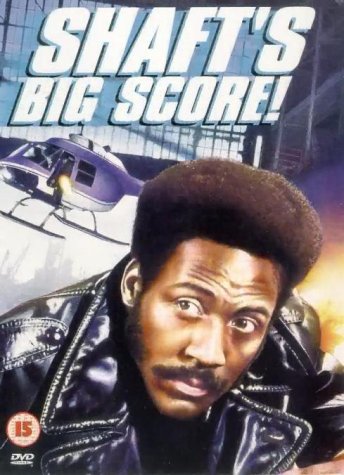
Shaft's Big Score!

'Shaft's Big Score'.  The score is money, or revenge, or possibly some sex.

'Shaft's Big Score!' has two things the original 'Shaft' lacks.  Firstly, an exclamation mark in its title.  Secondly, 'Shaft's Big Score!' has a helicopter in it.  That's the sum of its improvements and expansions.

You can tell the helicopter is a big deal.  The DVD's front cover shows John Shaft, his face showing urgency but not alarm, and behind him a looming helicopter.  One can reasonably spend 80% of the of the film in anticipation of a helicopter, wondering how and when it will explode (because any film with a helicopter on its cover or poster will, at the end, have a helicopter explosion - it's practically what these things are built for.  It's a wonder people still use them).

The film is otherwise very much like 1971's 'Shaft', but without the Isaac Hayes soundtrack.  'Theme to Shaft's Big Score!' imitates the earlier 'Theme to Shaft' in its potted biography interspersed with breathy 'Shaft's and 'John Shaft's, but comes across as a rip-off, like when Tennyson's 'Charge of the Light Brigade' proved so popular that he rushed out the near identical 'Charge of the Heavy Brigade'.  This film isn't really weaker than the first, or inherently worse, but the original was original, and this can't make that claim.

Just as 'Shaft' was adapted from Ernest Tidyman's novel of the same name, so this film is adapted from its second sequel (sadly skipping 'Shaft Among the Jews', which I'm reading at present, having found its title and cover too fascinating).  Once again, Shaft is on the trail of a weedy Caucasian with too little style and too many guns.  The baddie plays a clarinet in this one, and is after a large amount of money that's been hidden in a coffin, and was meant to be used to build an orphanage or somesuch.  The rest of the plot, a week later, is a bit of a blur, since I watched the Shaft trio in the space of three days, and this was comfortably the least amazing.

The action finale is where it's at, and was the only place from which I could draw a screen-capture that couldn't have come from 'Shaft'.  A chase with running, shooting, cars, speed-boat and that helicopter.  I certainly hope Jon Pertwee took the time to watch 'Shaft's Big Score!', as this sort of thing was right up his street - and may well have been the inspiration for the action part two of 'Planet of the Spiders'.  And does the helicopter explode?  Well I wouldn't want to spoil the end for you.

Shaft in Africa

'Shaft in Africa', or in fact, on a boat to France.

Now this is more like it.  Shaft is dispatched to Africa - mainly Ethiopia, but 'Shaft in Addis Ababa' doesn't sell the concept quite so well - and goes undercover to expose a people-trafficking operation run by a villainous and borderline-impotent white man (played here by Frank Finlay).

This is Shaft stripped down - without New York, or his usual allies, or his cool leather coat (which I envy, and was sad not to see here) - without any of his usual security.  Without his gun.  Shaft gets a dog, but it dies, so he has an overwhelmingly exciting wooden-pole fight with the man who killed it.

Until I saw this, the sole (and therefore best) people-trafficking film I'd seen was the maybe-kinda-racist 'Freight' (2010) in which my friend Jennifer Jordan played the career-defining role of 'Moldovian Woman 1', despite 'Moldovian' not being a real word.  'Shaft in Africa' knocks 'Freight' into a cocked hat, whatever that means, and is a far more interesting, exciting and emotionally involving depiction of this ongoing modern slavery.  It's depressing to think the problem was described so clearly in 1973 and is still going strong four decades later.

I'm inclined to say this film is just as good, and as socially aware as the original 'Shaft', and is a story worth telling.  Its status as a threequel and its lack of Oscar-winning theme tune have left it largely forgotten, but if you enjoyed 'Shaft', or enjoy Frank Finlay and want to see him talk about erectile disfunction and plan to shoot people and blow them up, this is certainly a film to investigate.


Have I tempted you to engage with either of these exciting motion pictures? Here they are on DVD, should you get the urge