Showing posts with label New York. Show all posts

Wednesday, 22 April 2015

Kids (1995)


Despite no particular plans in this direction, my film-watching project has encapsulated a lot of films set in New York - from 'Shaft' (1971) and 'Beneath the Planet of the Apes' (1971) to 'Taxi Driver' (1976) and 'Party Monster' (2003), and 'The BQE' (2007) and 'Mary & Max' (2009), and six others besides.  It's a very interesting set of movies, but taken together they present a vision of a formidably ghastly city, full of cars and violent woe, not somewhere you'd particularly want to live or visit.

'Kids' joins this tradition, but takes a new perspective, looking at the great teen nineties of baggy clothing and public urination.  It's a rampantly heterosexual movie, opening with an abrasively long and noisy teenage snog, and going on to follow the sex and lives of a pubescent gang.  Bored, horny children, raping and mumbling and laughing.

"I have no legs," sings the man.
I didn't know anything about the film when I bought it.  I picked it up from a charity-shop because I found its spine interesting - normally DVD-spines are printed so you can read them when you tilt your head to the right, but this one was like the DVDs of continental Europe, where you have to tilt your head the other way.  The design made it look like 'world cinema', a vague, arty term that I don't often hear applied to American movies, but this is a film seemed to fit both categories.

It's thrillingly disorientating, shot largely in very close-up close-ups and highly saturated colours.  A cast of untried actors overlap their dialogue, and compete with the sounds of traffic and loud music.  It has a documentary feel, a spontaneity.  It feels oddly like real life, rather than performed drama, and it makes other films feel staid and artificial.  I'd expected 'Kids' to be bleak and hard to watch - it's a film full of HIV, romanceless underage sex and other widely-protested content, but it proved to be full of energy and vitality - a much more visceral and important piece than, for example, 'The Titfield Thunderbolt' (1953), the last film I'd looked at.  It passed quickly, and it troubled me.

Sunday, 18 May 2014

The BQE (2007)


I claimed, when wrapping up the blog in December, that I would return to write about any particularly extraordinary movies that crossed my path.  Reader, I have found such a motion picture:  Sufjan Stevens' 'The BQE', an experimental presentation about the Brooklyn-Queens Expressway, setting forty minutes of well-chosen motorway to an amazing musical score.

The film does this with with a great enthusiasm and pace.  It's presented as a triptych of images, giving us three shots of the road at once, in extreme wide-screen.  Sometimes it's the same image three times, offset by a second or two.  Sometimes the cameras give us three different shots around a theme.  Occasionally one image, mirrored back and forth.  And sometimes, for variety, we see the Hooper Heroes, a trio of hula-hoop artists, Botanica, Quantus and Electress, splendidly arrayed in old-fashioned futuristic costumes, the sort of thing normally only worn by Sufjan Stevens himself, or avant-garde roller-derbyists.  They suit the expressway and the film perfectly.

The Hooper Heroes.  Their moves aren't perfect,
nor quite graceful, but they share the road's wonky energy.
'The BQE' has a great deal in common with 'Man With a Movie Camera' (1929), a film which left me enthused and delighted.  Both are silent films without conventional narrative, characters or captions, and both present the audience intense bursts of very ordinary voyeurism, intercut with the occasional staged sequence to keep us alert - and both films are sold on the basis of their composer, rather than their director or content.  The DVD release of the Ukrainian film is labelled 'Michael Nyman's Man with a Movie Camera'; the release of 'The BQE' is sold as a soundtrack CD, with the film included as a bonus.  Indeed, the CD packaging was so intense, so colourful, exciting and wilfully illegible, that I didn't realise the film was included until I got the set home.

Of course, in the case of 'The BQE', the director and the composer are one and the same, but I suspect the movie's main audience will be fans of Sufjan Stevens, entranced by the eccentrically baroque electronica of 'The Age of Adz', or 'Silver and Gold', or the quieter Indie pop of his earlier records, and curious to see how he might point a camera and aim an orchestra.  The result is engrossing and exciting, and makes the Interstate look by turns ancient, mechanical, exciting and sad.  The film isn't too long, and the images are well-chosen and artfully woven together.

The same shot, thrice, in high speed
This isn't just shot after shot of car after car, and the music is certainly interesting enough to support the images, moving from its opening 'Introductory Fanfare' to the grand finale, 'The Emperor of Centrifuge', with each track living up to the promise of its name.  I love the stillness of 'Dream Sequence in Subi Circumnavigation', and the way it grows into crashing Gershwinesque Americana.  I keep on turing my ear to the orchestral accelerando of 'Movement III: Linear Tableau with Intersecting Surprise' which bursts so satisfyingly into the electronica 'Traffic Shock'.  I enjoyed these first as music tracks, and felt rewarded when I finally saw them with pictures attached.  This is a very pleasing record and film, and I now care far more about this far-away road than feels reasonable.

P.S. IMDB lists the film as coming out in 2009, as that's when the DVD came out, as part-and-parcel of the soundtrack release. However, it was first screened in 2007, with live accompaniment, so that's the date I've accorded it here.

P.P.S. This isn't the only motorway-based film I've seen this May.  I also went to the cinema to watch 'Locke' (2014), an excellent piece of drama about a man in his car.  I've never seen a film like it, and I very nearly wrote it up for you, but didn't - except in this paragraph, which conveys all the salient points.  Why not go and watch it?


The BQE soundtrack and film come together, and even if you hate them both the packaging is astounding.

Thursday, 31 October 2013

Dragnet (1987) and Ghostbusters (1984)

Friday, with a chill dog, Streebek with salad
For four months now, it's been established that as soon as we had some hot-dogs in the house there would be an evening of hot-dogs and 'Dragnet', a reasonably enjoyable comedy based on a very sober old-time radio police-procedural of which I'm tolerant, even fond.

The great novelty of the original is that tries to present a realism, with characters umming and ahhing and making irrelevant or domestic conversation, just like in the real lives of police officers.  Time is taken while people walk from one side of the office to the other.  Joe Friday, the cop at the series' heart is not flamboyantly adventurous or heroic, he's a serious-minded public official doing his job.  It was the first radio series to be so dry, earnest and factually-based, so its main appeal in recent years (if I may call 1987 a recent year) is as an object to be parodied.

Friday and Streebek undercover as typical criminals
In this movie, Dan Akroyd plays Joe Friday, the nephew of the radio original, but very much the same in character.  He's obsessively precise and disciplined, and takes no time for fun, so his world is shaken up when he's partnered with the wise-cracking Pep Streebek (Tom Hanks), who is, by his standards excessively liberal.  I'm inclined to think Hanks overplays his role, making Streebek rather more manic than is needed: the concept for the film seems, originally, to have been pairing a ridiculous character with the intensely serious Friday, but Akroyd is too warm, and Friday too fun, to be a straight-man to Hanks's Streebek.  Indeed, Friday is so odd that he would have better been paired with somebody a little less hysterical.  Too often Hanks seems to be trying to steal the scene, where he could more profitably have shared it.  Akroyd is too good and too subtle to let his scenes be stolen.

In no time the two find themselves embroiled in a web of crime, a vast network of villainy known as P.A.G.A.N., criminals who engage in orgiastic dancing while wearing majestic goat-leggings and chanting 'kill the good', who impersonate police officers and seem to be linked in some way to the charismatic clergyman Jonathan Whirley, a fine performance by Christopher Plummer, who happens to be one of the actors I most like to watch.  It's a wonderfully clear-cut world of good and evil, and it knows it.


Oh, and a couple of weeks later we watched:

Ghostbusters (1984)


...which it seems only reasonable to mention at the same time, it being another fine eighties comedy with Dan Akroyd in a leading role.  If you haven't seen it, I shall explain in brief: there are some ghosts and some people who bust the ghosts and you should certainly watch it today as it is an embarrassing hole in your education that will be enjoyable to fill.

But of course you've seen 'Ghostbusters', and isn't it excellent?  I really haven't a word to say against it.  It was just the thing to test out the new television (the old one having perished of old age), and I could watch it again tomorrow, if this Penciltonian project wasn't pressing me toward less familiar years.


Thursday, 26 September 2013

Beneath the Planet of the Apes (1970)


This sequel to 1968's sci-fi classic 'Planet of the Apes' spends its first half telling the same story again with a different astronaut, but in the second half moves unexpectedly to an underground realm of skinless psychics who sing hymns to a gigantic bomb.

Like the earlier film, it starts eerily, with wide empty spaces, perils of nature and troubling mysteries even before we reach the Apes.  Here, too, there's a lengthy sequence where our hero isn't permitted to speak, but must nonetheless get things done - it's always good, in this visual medium, to have a respite from talking.  We then get the same exposition and capture-and-escape antics as last time, before the new mystery and fresh ideas are allowed to take hold.

The Apes look pretty good here, riding to war.  When they get there their
lack of numbers and weapons makes the conflict seem terribly small-scale.
It isn't very clear why they go to war, nor who they expect to fight.
Charlton Heston has opted out, so his character, Taylor, is written out at the start (once we've seen a reprise of the earlier film's famous ending) and only returns in the dying minutes, to have an excellently exciting mace fight with this film's Taylor-substitute, Brent (James Franciscus).  There's a rare thrill to seeing the hero of a film you're watching fight to the death with the hero of an earlier, better movie.  We're torn over which we want to win, or we're meant to be.  Brent has the advantage that we've spent an hour getting to like him, but Charlton Heston is Charlton Heston, and though he fights the more savagely, he seems the more original of the two.  Perhaps if Brent hadn't been so clearly a Heston-lite it would seem a fairer competition.

Charlton Heston turns up, eventually.
There was a brief period when the outlandish bomb-worship and the film's excessively destructive climax made this my favourite of the five classic Apes movies.  I came round, in the end, to the greater merits of the '68 original, but think I would claim the third film, 'Escape from the Planet of the Apes' (1971) as the best of the bunch, a weird fish-out of water comedy in modern-day America which very slowly darkens into a bleak and unfair tragedy, its villain genuinely trying to save humanity, and its dearth of Charlton Heston made up for by the presence of Ricardo Montalban.

They're appealing films, each one more utterly miserable in its findings than the one before.  The first is about how human appetite for destruction never ceases, the second about how we cause the end of the world, and it somehow gets even worse as the series goes on, with films about killing babies and smashing people's heads in as borderline-legitimate ways to make the world better.  The movies have the most paranoid soundtracks, an alarming and unusual set of noises for an orchestra, at the time - and they're attractive to look upon.  I always envy Taylor's linen mace-fighting jacket in this instalment, and if I hadn't broken my sewing machine I would  surely have replicated some of the Apes' garments by now, pleasing designs which look like no human culture I could name.

This is probably the only Apes movie where you could take the Apes out
and the plot would still more-or-less work.  Nice costumes, though.
The things that most date the film to 1970 (or more properly to the late sixties when it was written and filmed) are the use of wild camera zooms and the fact that the only notable African American character is simply credited as 'Negro', which any later would surely have seemed questionable.  The film is also quite Vietnam-flavoured, with the Gorillas going into battle, but first breaking up ineffectual anti-war protests by the Chimpanzees.  On the day I viewed this film I went along to an unfortunately unpeopled anti-fascist rally, so I was rather relieved to see this film present an even smaller and less effective protest by which I could make some happier comparison.


P.S. Brent spends the film looking for Taylor, but never expresses an interest in the three astronauts who travelled with him.  Presumably he knows which of the four was played by Charlton Heston.


Tuesday, 17 September 2013

The Godfather (1972)


1971's 'Shaft' and 1972's sequel 'Shaft's Big Score!' seemed terribly similar to one another, seeming to present too homogenous a picture of the early seventies, so I resolved to watch another film for one or both of the years, to get a little variety in.  Since I felt I'd ill-appreciated the movie when I first saw it in 2007, I thought I'd watch 'The Godfather', commonly regarded as one of the greatest movies of the Twentieth Century.

Well, it turns out to be excellent.  It feels much more relaxed, more lifelike than 'Doctor Zhivago' (1965), for instance (if I may take an example of a substantial film from the previous decade, the direction and storytelling of which I had applauded).  But you don't need me to commend 'The Godfather'.  So many words have been spent, this last 41 years, in this film's praise that it would be a waste of your time for me to say anything more.

P.S. This is why The Penciltonian won't even be watching 'Citizen Kane' (1941)

P.P.S. I'm aware I've replaced one 1972 New York crime movie with another, but they're as different as they could be.  Nobody would have thought to append an exclamation mark to this movie's title.


Sunday, 21 July 2013

Party Monster (2003)

James St James meets an impressionable Michael Alig
I'm coming around to the idea that interesting movies will generally be good movies, or at least worth the watching, so when my lodger Saskia described 'Party Monster' as interesting (indeed, as 'interesting') I knew it had to be Penciltonized.

The film is set in the club scene of '80s New York, but manages to look and feel, in some rather bizarre ways, timelessly modern rather than dated to that era.  It regards two extremely flamboyant and bitchy young socialites, Michael Alig (Macaulay Culkin, who surprised me by being excellent here) and James St James (Seth Green, an actor I always enjoy) - their club nights and their domestic life.  Michael and James live wilfully grotesque lives, never resting from their highly-strung, drug-frenzied Noel Cowerd schtick, all played out in drag and magnificent clubwear.  As the movie starts, the pair bicker self-consciously, quite aware that they're on camera, each vying to narrate their version of the tale.  Michael mentions, casually and without regret, that he's committed a murder, and as per 'Double Indemnity' (1944) the body of the film is in flashback, showing how the murder came to occur.  It's a true story, by the way.

Michael in characteristically alarming array.
The film was made on a tiny budget, its resources wisely spent on a strong and witty script, good actors who manage to make potentially shrill characters sympathetic, and a huge bevy of excellently alarming costumes.  Indeed, while I call it a film, it appears to have been shot on videotape rather than film, and with next to nothing in the lighting department, meaning that any keen amateur could have made their own version with a remarkably similar look.  It's rather disconcerting, as a maker of amaeur motion-pictures, to see a cinematic release so similar in picture quality and colour to my own crude works, and it lends the thing an air of a home-movie, as if Michael and James are not just narrating their own history, but have put together a video presentation about their adventures.

Michael and James are intriguing characters, and, presumably, people.  They're on all the time, always in costume and putting on characters, for themselves as much as for their peers, who they treat as an audience.  It's like 'Withnail and I' (1987), but with two Withnails and no I.  I felt for them in their superficiality; I wanted to see them relax, to be themselves rather than exhausting themselves with masks.  I didn't want to see them be normalised or become mundane, just to relax, to be honest with themselves.  It's the difference between being naturally eccentric (which is commendable) and being an eccentric.  Imagine being John Mccrirrick.  Now imagine being John Mccrirrick every day for the rest of your life.  It could be a wild novelty, but pursued as a lifestyle it would be exhausting, and would soon be no fun at all - a cry for help, and one that could lead to a tremendous breakdown.  Now, there's much to be said for dressing up, and far too few people dress interestingly; I'm a great advocate of all manner of fancy-dress antics, but there have to be some moments of some days where you dress for yourself, and as yourself, rather than merely to impress, alarm and intimidate your audience.  The only time Macaulay Culkin ever seems truly relaxed here, he isn't wearing anything at all.  For a brief scene towards the end of the movie, he takes a bath, and seems blissfully, innocently happy.  He loses nothing of his character, his mirth or habitual androgyny here, but seems to have a peace he's spent the rest of the film avoiding.

Angel, the dealer, starts as a leatherman but is encouraged to dress up to his name and station.
He was the victim of the aforementioned murder.
It is an interesting film, and I'm tempted to say it's also an excellent one.  It's aesthetically thrilling, has an fine soundtrack, and as I've noted, a script and cast worth hearing and watching.  It's also a world away from the other films I've written up to represent the early 2000s.  The Club Kids, those persistent and obsessive clubbers who formed Michael's entourage, come across like an anti-political Baader Meinhof gang, and their story is as fascinating as it is colourful, and this film's telling is simultaneously great fun and disconcertingly serious.


...and here it is on shiny disc, though I watched it on Netflix meself.

Sunday, 7 July 2013

Mary & Max (2009)


My friends Cassandra and Fnord recommended me this film, and lent me a copy, urging me to watch it without my first finding out anything about it.  When I saw them next, they lent me another copy, and it became apparent that they thought I should see it, and would enjoy it.  Now, Cassandra and Fnord make very good recommendations, and know me as well as anybody can be said to, so I found some time and lent it my attention, and oughtn't to have been surprised when it turned out to be excellent.

It tells the story of Mary, a young girl in a sepia-toned Australia striking up an unlikely pen-friendship with Max, a middle-aged man in monochrome New York.  Mary is lonely but habitually optimistic while Max is weary, socially awkward and extremely solitary.  Despite the fact that
both live rather bleak lives filled with tragedy, the story of their friendship manages to be light, fun and charming, though always terribly sad.

Mary, with her rooster Ethel.  Her favourite colour is brown.
The film plays into a few of my interests quietly indulges my love of toilet humour and cheery grotesquery.  From the off we learn that Mary has a birth-mark 'the colour of poo', and that her father has retired to his shed to taxidermise alarmed-looking birds he's found.  It's never horrid or disgusting, but borders on the naughty.

The whole film is led by a narrator, the calm and reassuring Barry Humphries, with the vast majority of dialogue either given in his affable narration or in the letters written from Mary to Max or typed in return.  Were the images not so compelling - fascinating, blanched and misshapen claymation - one could almost enjoy the work entirely on audio.  The film doesn't hurry to make its points, but takes its time showing to show us beautiful things.

One of Max's lists.
The characters are few, meaning we grow to know Mary and Max extremely well as the former grows older and the latter broader.  We see calamities in their surroundings and their friendship that they can't see or understand, and I, at least, spent half the film hoping they could one day meet in person, and the latter half fearing that such a difficult meeting had grown inevitable.

I've already described it as beautiful, sad, fun and charming, and don't particularly like to repeat myself, nor want to inflict thesaurus-scrapings on you, but I don't think I can better describe the film than that.  There's plenty more to it that I'd love to enthuse about, but it's better that you see it for yourself.


Here it is on shiny disc, if you have the urge.  Some nice looking extras on there, too, but I really do commend the main feature to you.

Sunday, 5 May 2013

Breakfast at Tiffany's (1961)

Cigarettes aren't cool, except this one.
For some reason, I always imagined this would be in monochrome.  It's a title I've often heard, and I know the famous poster, and I've been coasting on certain assumptions from that, it seems.  What did I know about this film before I saw it?  I had a notion it was a classic, probably a romance or romantic comedy, and that it was exceptionally classy.

So why, if it's clearly a good, cool, and well-regarded film, had it never been placed before me?  I couldn't think of anyone who claimed it as their favourite, or had enthused to me about it, as they do about other famous romances of the forties and fifties (decades to which I'd hitherto tied this work of the early sixties).  I believe the answer may be this: Mr. I.Y. Yunioshi.

Mickey Rooney as I.Y. Yunioshi
In the midst of a highly entertaining romantic comedy, Mr Yunioshi is a grotesque Japanese stereotype played outrageously and with great gusto by a yellowed-up Caucasian.  This, as we have learnt in more recent decades, is just not on.  Indeed, by the sixties, they really ought to have known better.  He's not in much of the film, but when he's on-screen he's certainly noticeable, and he's the second character to appear, so his outlandish role and performance are some of the first things to meet the unprepared viewer.

I'm tempted to go on saying 'if we ignore this unfortunate blemish, the film is great fun,' and so on, but I'm not sure casual racism is something we ought to ignore.  Now, I'm more liberal than some on the issue of blacking up, yellowing up and such, and will offer an attempt at defence of Laurence Olivier's Othello in 1965, or John Bennett's Li H'sen Chang in 'The Talons of Weng-Chiang' (1977), as it's just feasible that they were the best of the available actors for those dramatic roles at the time, but Mickey Rooney's performance here just takes the biscuit: histrionic, clumsy, myopic and perpetually outraged, with the gigantic teeth that one can likewise find in inherently horrible Japanese characters in Hergé's Tintin.

Seized by a compulsion, Holly and Paul shoplift some animal masks.
The rest of the film is good, is funny, and touching.  It's a fine romance and a successful comedy, and the characters are likable and complex enough to be genuinely interesting.  Audrey Hepburn plays the lead, Holly Golightly, a role written for Marilyn Monroe, an eccentric young socialite who meets a handsome writer (George Peppard, later known for 'The A-Team' in the 80s).  The two get on well, cavort most merrily, and in general have a highly-charged friendship that is probably romantic, though the two seem reluctant to make that overt.  It's a format that I particularly enjoy, so I found myself somewhat anguished when, inevitably, complications of history, money and future arise in the film's midst and pretty much destroy the relationship's merits and prospects.  They'd been so innocently happy together (and in a brief moment of petty shoplifting, guiltily happy) that it seems everything is rather irreparably spoilt.

There's hope, on and off, though I shan't say any more about what ensues.  It's a well-written film, adapting a novella by Truman Capote, which seems to be enough of a selling-point that I ought at least to mention it.  As I intimated above, I can't quite come to recommend it, as Mr. Yunioshi is a small but significant sour point in something that ought to be sweet.  On the basis of his appearance, planned screenings of the film are on occasion cancelled or boycotted, and the reputation of the whole is marred.


Nonetheless, here's your chance to exercise your rights as a materialist.

Tuesday, 26 February 2013

Taxi Driver (1976)


I mentioned my film-watching antics to my friend Rob Reed, who lectures in film-related things, so seemed likely to suggest films I hadn't seen and wouldn't have thought of.  He knows how ignorant I am of cinema (or rather, he knows which areas of film I've fixated on, and therefore what I've missed), and, when Christmas came, gave me a film wrapped in festive paper.  'Taxi Driver' was that film (or else this paragraph would seem irrelevant, would it not?).  

The only Martin Scorsese-directed films I'd seen at this point were 'The Last Temptation of Christ' (1988) and 'No Direction Home' (2005), a documentary about Bob Dylan - both of which apparently lay some way outside his usual style.  I had a notion that his films were violent, dark, and full of Italian-Americans shouting at each other (a prospect I've now found hails from his 1990 work 'Goodfellas', which Rob likewise pressed into my hands).

Oh look, some guns.

I suspected that this film would lead to a violent finale, but I wasn't certain even of this.  For the first half-hour, this could just turn into an idiosyncratic romantic comedy, except that our taxi-driving protagonist is just a tad too intense, too socially awkward, and then increasingly so.  For some reason, it hadn't to me occurred at all that the plot would actually be about a man driving a taxi around, but that's how it went.

From the off this was far more attractive than the other 70s films I've looked at so far.  Richer, more menacing, with the taxi prowling, leonine.  We see Robert de Niro thinking, as he drives his taxi, but we don't know what about.  Even in his narration, he gives few clues.  Only the music is overtly menacing - and it's Bernard Hermann composing, so it could hardly be otherwise.

I'll jump past the main body of the film, as I've no interest in reciting synopses in this blog.  In what I took to be the final ten minutes, the film seems to slip into another genre - the practiced violence, the spree I'd spent the last hour preparing for, is far, far dirtier, less clean and easy than I'd expected.  The colours fade and the world slips into slower and slower motion until time seems to stop to show us the whole mess.  Then, when I most expected the film to end, it doesn't.  There are five or ten more minutes, which serve to make the scenario even more unsettling, the idea that the events in this film could happen anywhere, to anyone, for no particular reason.

Bang!

I sometimes wonder what it's like to live in America, where films such as this are set, not in some bigger, cooler, distant and more important nation, but in your homeland.  The States always seem much grander that Britain, even when that just means grimmer and more horrible - and the accents, to one who never visited, mark New York out as a genre rather than a region.

Anyway, I feel I've been writing too many words about some films lately, so, while I could go on rather longer, I'll curtail this here.  Less is more, as they say.

P.S. Since the last update was from the 60s and this was from the 70s, you can expect an 80s film on Thursday, a 90s one on Sunday, and so on, until I grow bored and frustrated with the pattern.  It might prompt me to finally watch something from the 1950s, a decade untouched by the last forty-four films I've watched over the past four months.


The film, if you yearn for it.

Sunday, 13 January 2013

Shaft (1971)


Q. "Who is the man / Who would risk his neck for his brother man?"

Film has given us any number of possibles here, so perhaps we should try a different question.  Points off for rhyming 'man' with 'man', by the way.

Q. "Who's the cat who won't cop out / When there's danger all about?"

Macavity?  Thomas O'Malley, perhaps?  We need something more specific.

Q. "Who's the black private dick / Who's such a sex machine with all the chicks?"

Ah.  I have only one answer here, and it's the one the song brands 'damn right'.  Shaft!

"You ain't so black"

 
"And you ain't so white, baby"

I had the soundtrack on LP long before I saw the film, and you too likely know the song better than the movie.  The passage of time has rendered Isaac Hayes' Academy-Award-winning theme tune a little camp, and when I finally saw 'Shaft' I was slightly disappointed how little the film seemed to match it.  I think I'd expected blaxploitation to be somehow more fun, more self-parodic.  As with 'Yellow Submarine' (1968) I'd seen this sort of thing pastiched and referenced so much I expected the original to be aware of its own legendary status.  I suspect the 'Shaft' remake of from the year 2000 will be somewhat closer to the knowingly iconic piece I was expecting.

It's a crime film, as you may either know or guess.  Shaft is a detective, and he doesn't like to be messed around.  Being black in downtown New York and being a one-man detective agency (because he doesn't like to work for the man), people try to mess him around quite a lot.  From his opening 'up yours!' to an impatient taxi-driver, and his hurling an aggressive client out of the office window, John Shaft strives constantly, defending his right to get on with his job unhassled.

They say this cat Shaft is a bad mother...

In British fiction, I think it's relatively unusual for characters' ethnicities or colour to be important to their stories.  UK-style multiculturalism prefers colour-blind scripts where characters' names rather than actions or allegiances tell us their ethnic origin.  (The one exception that comes to mind is another crime thriller, 'Gangsters', from 1976-78, a willfully absurd TV series about Indian, Pakistani and Chinese gangs in 70s Birmingham).  In America, however, in film and TV across the decades, skin-colour seems to have far more bearing on characters and their predicaments.  Shaft is reluctant to work too closely with Lt Anderozzi of the NYPD, especially if working against the black Bumpy Jonas.  In the sequel 'Shaft's Big Score!' (1972) he condemns a black cop for being a 'honky'.  It's almost convenient that in this film and its two sequels the major villains turn out to be white.

It was this racial subtext (and, indeed, text) that I wholly missed the last time I watched this film.  Had I watched it in the 1970s it would have been far more obvious to me, but viewing this in the noughties I took it simply as a slightly ordinary crime drama about characters versus characters, rather than John Shaft as a black detective in a town where that means anonymity, lack of credibility, and a need to fight hard.

Is it a good film?  Well, it's moderately interesting and exciting.  It doesn't aspire to be as cinematic as its sequels (both were made in wider widescreen, and with far more spectacle, exploding helicopters and such - though I think this is the more engagingly directed), but Shaft himself is a very strong and enjoyable hero.  He's quick to anger, yes, but knows how to keep his cool when it's to his advantage.  He has an enjoyably immature sense of humour and always looks great - watching the Shaft films followed by a pair of films set in the Berlin underworld of the 1930s, I suffered a great deal of coat-envy.  In short, the film itself is a fair thriller but a touch drab, and it's Richard Roundtree's performance as John Shaft that really seized my attention, coaxing me me to return to the film and to seek out the sequels.


Compelled to watch it for yourself?  Oh, I see, you just wanted the theme tune? Well, suit yourself

Monday, 17 December 2012

Sequels to 'Shaft' (1972, 1973)


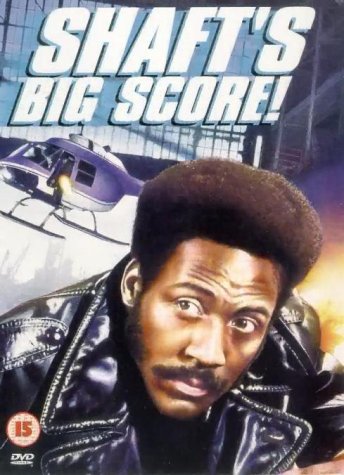
Shaft's Big Score!

'Shaft's Big Score'.  The score is money, or revenge, or possibly some sex.

'Shaft's Big Score!' has two things the original 'Shaft' lacks.  Firstly, an exclamation mark in its title.  Secondly, 'Shaft's Big Score!' has a helicopter in it.  That's the sum of its improvements and expansions.

You can tell the helicopter is a big deal.  The DVD's front cover shows John Shaft, his face showing urgency but not alarm, and behind him a looming helicopter.  One can reasonably spend 80% of the of the film in anticipation of a helicopter, wondering how and when it will explode (because any film with a helicopter on its cover or poster will, at the end, have a helicopter explosion - it's practically what these things are built for.  It's a wonder people still use them).

The film is otherwise very much like 1971's 'Shaft', but without the Isaac Hayes soundtrack.  'Theme to Shaft's Big Score!' imitates the earlier 'Theme to Shaft' in its potted biography interspersed with breathy 'Shaft's and 'John Shaft's, but comes across as a rip-off, like when Tennyson's 'Charge of the Light Brigade' proved so popular that he rushed out the near identical 'Charge of the Heavy Brigade'.  This film isn't really weaker than the first, or inherently worse, but the original was original, and this can't make that claim.

Just as 'Shaft' was adapted from Ernest Tidyman's novel of the same name, so this film is adapted from its second sequel (sadly skipping 'Shaft Among the Jews', which I'm reading at present, having found its title and cover too fascinating).  Once again, Shaft is on the trail of a weedy Caucasian with too little style and too many guns.  The baddie plays a clarinet in this one, and is after a large amount of money that's been hidden in a coffin, and was meant to be used to build an orphanage or somesuch.  The rest of the plot, a week later, is a bit of a blur, since I watched the Shaft trio in the space of three days, and this was comfortably the least amazing.

The action finale is where it's at, and was the only place from which I could draw a screen-capture that couldn't have come from 'Shaft'.  A chase with running, shooting, cars, speed-boat and that helicopter.  I certainly hope Jon Pertwee took the time to watch 'Shaft's Big Score!', as this sort of thing was right up his street - and may well have been the inspiration for the action part two of 'Planet of the Spiders'.  And does the helicopter explode?  Well I wouldn't want to spoil the end for you.

Shaft in Africa

'Shaft in Africa', or in fact, on a boat to France.

Now this is more like it.  Shaft is dispatched to Africa - mainly Ethiopia, but 'Shaft in Addis Ababa' doesn't sell the concept quite so well - and goes undercover to expose a people-trafficking operation run by a villainous and borderline-impotent white man (played here by Frank Finlay).

This is Shaft stripped down - without New York, or his usual allies, or his cool leather coat (which I envy, and was sad not to see here) - without any of his usual security.  Without his gun.  Shaft gets a dog, but it dies, so he has an overwhelmingly exciting wooden-pole fight with the man who killed it.

Until I saw this, the sole (and therefore best) people-trafficking film I'd seen was the maybe-kinda-racist 'Freight' (2010) in which my friend Jennifer Jordan played the career-defining role of 'Moldovian Woman 1', despite 'Moldovian' not being a real word.  'Shaft in Africa' knocks 'Freight' into a cocked hat, whatever that means, and is a far more interesting, exciting and emotionally involving depiction of this ongoing modern slavery.  It's depressing to think the problem was described so clearly in 1973 and is still going strong four decades later.

I'm inclined to say this film is just as good, and as socially aware as the original 'Shaft', and is a story worth telling.  Its status as a threequel and its lack of Oscar-winning theme tune have left it largely forgotten, but if you enjoyed 'Shaft', or enjoy Frank Finlay and want to see him talk about erectile disfunction and plan to shoot people and blow them up, this is certainly a film to investigate.


Have I tempted you to engage with either of these exciting motion pictures? Here they are on DVD, should you get the urge